

Ngorongoro Crater: How to Plan a Safari in 2026
Ngorongoro Crater is a UNESCO-listed volcanic caldera in northern Tanzania. It can best be visited on a one-day game drive between June and October, the dry season. Expect a per-person conservation fee plus a per-vehicle crater fee [VERIFY: current rates], and book a 4×4 with a licensed guide. From Arusha, the drive takes roughly 3.5 to 4 hours.
Last updated: [17-10-2026]. Reviewed for accuracy on [17-10-2026] by Team of Travel.
Key takeaways
- The crater floor holds permanent wildlife, including lions, hyenas, hippos, elephants, and black rhinos, so sightings are strong year-round.
- The dry season (June to October) gives the easiest roads and clearest viewing. The green season (November to May) has fewer vehicles and lower lodge prices.
- Fees are charged per person and per vehicle, and they change. Confirm them with the NCAA before you budget.
- Book your crater descent, not just your lodging. Slots and hours are limited [VERIFY].
- Pair the crater with the Serengeti, Lake Manyara or Tarangire for a fuller safari.
At a glance
| Detail | Info |
|---|---|
| Location | Ngorongoro Conservation Area, Arusha Region, northern Tanzania |
| Managing authority | Ngorongoro Conservation Area Authority (NCAA) |
| Nearest city/gateway | Arusha (main safari hub); Karatu (closest town) |
| Nearest airports | Arusha Airport (ARK), Kilimanjaro International (JRO), Lake Manyara airstrip [VERIFY: scheduled flights] |
| Best time | June to October (dry season); January to February for calving in the nearby Ndutu area |
| Entrance fee | [VERIFY: conservation fee, crater service fee and vehicle fee, in USD] |
| Time needed | 1 full day for the crater; 2 to 3 days with the wider conservation area |
| Difficulty | Easy (vehicle-based); crater rim sits at roughly 2,200 m, so evenings are cold [VERIFY] |
| Permits | Entry paid via NCAA systems; walking activities need a ranger [VERIFY] |
| Protected status | UNESCO World Heritage Site, inscribed 1979 [VERIFY: year and criteria] |
Introduction to Ngorongoro Crater
Ngorongoro is one of the few places in Africa where you can see large mammals in a compact, enclosed landscape. The crater is a caldera, a large basin formed when a volcano collapses into itself. Its floor is wide and open, so animals are easy to spot, and most tours finish in a single day.
This guide covers the Ngorongoro Crater safari from a planning angle: when to go, what it costs, how to get there, where to stay, and what to avoid.
What is Ngorongoro Crater and why visit?
Ngorongoro Crater is a collapsed volcanic caldera, roughly 600 m deep and 19 km across, inside the larger Ngorongoro Conservation Area [VERIFY: dimensions]. The floor covers about 260 square kilometres [VERIFY] and includes grassland, Lake Magadi (a shallow soda lake), swamps and a small forest.
Reasons to go:
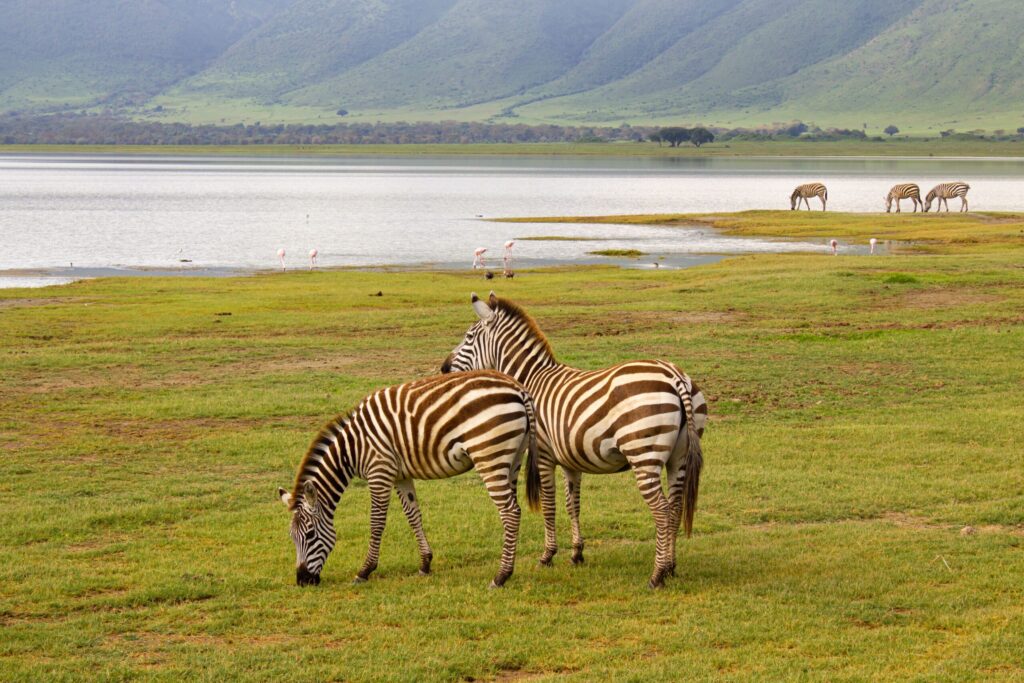
- Concentrated wildlife. Lions, spotted hyenas, buffalo, elephants, hippos, zebra and wildebeest live in the crater. It is also one of the more reliable places in Tanzania to see black rhino, though sightings are never guaranteed and often distant.
- Scenery. The rim viewpoints look down onto the full basin.
- Layered heritage. The conservation area includes Olduvai (Oldupai) Gorge, a key site in human origins research, and is home to Maasai pastoralists.
- Multiple ecosystems. The wider area includes highland forest, crater lakes, and open plains.
[ADD FIRST-HAND NOTE: your first view from the rim, light, temperature and what you saw first on the floor.]
When is the best time to visit Ngorongoro Crater?
The best time for most visitors is June to October, when roads are drier, and animals gather near water. The crater works year-round, but heavy April and May rains can slow roads and cloud the rim.
| Month | Weather | Crowds | Notes |
|---|---|---|---|
| January to February | Warm, short showers | Moderate | Wildebeest calving in the nearby Ndutu plains [VERIFY]; good for predators |
| March to May | Long rains | Low | Lowest prices; muddy roads; lush scenery |
| June to August | Dry, cool, clear | High | Best overall viewing; cold mornings on the rim |
| September to October | Dry, warmer | High | Excellent sightings; dusty |
| November to December | Short rains | Moderate | Green landscapes; rain usually in bursts |
Trade-off to know: the dry season is the busiest, and the crater floor can feel crowded at popular spots such as the hippo pool. Going early helps, and so does asking your guide to skip the busiest stops first.
How do you get to Ngorongoro Crater?
Most visitors drive from Arusha, about 3.5 to 4 hours [VERIFY] by road. The route runs through Mto wa Mbu, Karatu, and the Lodoare Gate.
- Fly into Kilimanjaro International (JRO) or Arusha Airport (ARK). International visitors usually land at JRO.
- Transfer to Arusha. JRO to Arusha is typically about 1 hour [VERIFY].
- Drive west on the main safari road via Makuyuni and Mto wa Mbu.
- Climb to Karatu. This is the last major town and a common overnight base.
- Enter the conservation area at the Lodoare Gate and follow the rim road to your lodge or campsite.
- Descend into the crater at one of the designated descent roads, accompanied by your guide-driver [VERIFY: current descent and ascent roads].
Other options: light aircraft flights from Arusha or the Serengeti can land at the Lake Manyara airstrip, with a road transfer afterward [VERIFY: schedules and routes]. Self-driving is possible in Tanzania, but crater descents typically require an approved guide [VERIFY].
How much does it cost to enter Ngorongoro Crater?
Costs have three parts: a per-person conservation fee, a crater service fee, and a per-vehicle fee. All figures below are estimates and must be confirmed with the NCAA.
| Fee type | Estimated amount | Notes |
|---|---|---|
| Conservation area entry (non-resident adult) | [VERIFY: USD per person per 24 hours] | Children’s rates are lower [VERIFY] |
| Crater service fee | [VERIFY: USD per vehicle] | Charged for each descent |
| Vehicle fee | [VERIFY: USD] | Depends on vehicle type |
| Guide/camping / other | [VERIFY] | Varies by operator and site |
Where payments happen: fees are typically paid by your operator via a card system, and cash may not be accepted at the gate [VERIFY]. Ask your operator to confirm what is included in your quote.
Rules to check: crater descent hours (commonly early morning to mid-afternoon), maximum time on the floor, and whether you must exit by a set time [VERIFY]. Never assume these stay unchanged between seasons.
What are the top things to see and do?
The core activity is a half-day or full-day game drive on the crater floor, with the rim viewpoints and a picnic stop as supporting highlights.
- Game drive on the crater floor. Look for lion prides on the open plain, hyenas near the lakeshore, and hippos at the springs.
- Ngoitokitok Springs picnic site. A common lunch stop with hippos and birds [VERIFY: current picnic rules].
- Lake Magadi. A soda lake that can hold flamingos at certain times of year.
- Rim viewpoints. Best at early light or late afternoon.
- Birdwatching. The crater has grassland, wetland, and woodland birds. Ask your guide for target species.
- Cultural visits. Maasai bomas (homesteads) are in the conservation area. Choose ethical visits arranged through reputable operators, and ask where fees go [VERIFY].
- Olduvai (Oldupai) Gorge Museum. Between the crater and Serengeti, with exhibits on early human discoveries [VERIFY: opening hours and fee].
Which tours and activities are available?
| Option | Duration | Difficulty | Best for |
|---|---|---|---|
| Crater game drive | 6 to 8 hours | Easy | Everyone, including families |
| Empakaai Crater rim hike | Half to full day | Moderate | Active travelers; needs a ranger [VERIFY] |
| Ol Doinyo Lengai climb | Overnight | Hard | Experienced hikers [VERIFY: permits and conditions] |
| Olduvai Gorge visit | 1 to 2 hours | Easy | History and science fans |
| Lake Eyasi cultural trip | Half day | Easy | Cultural-minded visitors |
Who this is for: first-time safari-goers, families, photographers, and anyone short on time.
Who might skip it: travelers who want empty landscapes, those sensitive to altitude and cold, or anyone on a very tight budget, since fees are high compared with some other parks.
Where should you stay near Ngorongoro Crater?
Stay on the crater rim for views and early access, in Karatu for lower prices, or in a nearby safari lodge for a quieter base.
| Area | Typical style | Budget level | Notes |
|---|---|---|---|
| Crater rim | Lodges with crater views | High | Closest access; cold nights |
| Karatu | Mid-range lodges, guesthouses | Low to mid | About 30 to 60 minutes to the gate [VERIFY] |
| Rim campsites | Public and special campsites | Low | Basic facilities; check availability [VERIFY] |
| Lake Manyara area | Tented camps and lodges | Mid | Easy to combine with Manyara |
| Serengeti-side camps | Tented camps | Mid to high | Good for longer routes |
Tip: rim lodges with a crater view often cost much more than rooms a short drive away. If you are mostly there for the game drive, Karatu may be better value.
Sample itineraries
One day (from a Karatu or rim base)
- Leave your lodge around dawn.
- Pass the descent road and enter the crater at opening time [VERIFY].
- Spend the morning on predators and open plains.
- Picnic lunch at the springs.
- Afternoon drive around Lake Magadi and the forest edge.
- Ascend and exit before the required time [VERIFY].
Three days (Arusha circuit)
- Day 1: Arusha to Lake Manyara National Park; overnight near Karatu.
- Day 2: Full-day Ngorongoro Crater game drive; overnight on the rim or in Karatu.
- Day 3: Optional Olduvai Gorge stop, then continue to the Serengeti or return to Arusha.
Is it safe? Safety and responsible travel
Ngorongoro is generally safe for vehicle-based visitors when you follow your guide’s instructions. Wildlife is wild, and conditions can change.
Safety
- Stay inside the vehicle unless your guide says it is safe, and never approach animals on foot.
- The rim is cold and windy. Bring warm layers, especially for dawn drives.
- Altitude on the rim can affect some people. Speak to a doctor if you have health concerns, and ask rangers for local guidance.
- Check official travel advisories and road conditions before you go [VERIFY].
Responsible travel
- Keep your distance from animals and do not feed them.
- Do not leave litter. Pack out what you bring in.
- Use licensed guides and operators.
- Ask before photographing people, and respect local and Maasai communities and their land use.
- Drones are typically restricted in protected areas [VERIFY: current rules].
How much does a Ngorongoro Crater safari cost?
A rough budget guide, to be adjusted with real quotes:
| Item | Budget traveler | Mid-range | Higher-end |
|---|---|---|---|
| Accommodation (per night) | [ESTIMATE] | [ESTIMATE] | [ESTIMATE] |
| Park fees (per person) | [VERIFY] | [VERIFY] | [VERIFY] |
| Vehicle and guide | Shared group tour | Private 4×4 | Private 4×4 with extras |
| Food and drinks | Packed meals | Lodge meals | Full-board |
| Tips for guide and staff | Customary; amount varies |
Always ask your operator what is included in a quote.
What else is nearby?
- Lake Manyara National Park: known for its lake and wildlife.
- Tarangire National Park: known for elephants and baobab trees.
- Serengeti National Park: vast plains and the migration.
- Olduvai (Oldupai) Gorge: archaeological site and museum.
- Empakaai Crater: a forested caldera with a lake.
- Ol Doinyo Lengai: an active volcano considered sacred by the Maasai.
Comparison: crater safari or Serengeti?
| Factor | Ngorongoro Crater | Serengeti |
|---|---|---|
| Time needed | One day | Two or more days |
| Scenery | Compact, enclosed | Vast plains |
| Wildlife | Resident, dense | Migration-dependent |
| Cost | High per day | Often higher overall |
| Best for | Short trips, first-timers | Longer trips |
What should you pack?
- Warm layers, fleece and a windproof jacket
- Light, neutral clothing for daytime
- Hat, sunglasses and sun cream
- Binoculars and a camera with a zoom lens
- Closed shoes and a small day bag
- Reusable water bottle
- Cash for tips [VERIFY: accepted currencies]
- Any personal medication
- Power bank
What mistakes should you avoid?
- Assuming fees stay the same. Verify them before you pay.
- Booking only one night and arriving late. You may miss the early descent window.
- Underestimating the cold on the rim.
- Choosing the cheapest tour without checking vehicle condition and guide credentials.
- Expecting guaranteed rhino sightings.
- Ignoring weather. Rain can affect roads and views.
- Skipping a rim stay when you want sunrise views.
Frequently Asked Questions About Ngorongoro Crater
How long do you need for the Ngorongoro Crater?
Most visitors spend one full day on the crater floor. Allow two to three days if you also want to visit Olduvai Gorge, Empakaai Crater, or nearby parks. Start early, because descent hours and exit times apply [VERIFY].
What is the best time to visit Ngorongoro Crater?
June to October is the most popular because roads are drier and viewing is clearer. November to May is greener and quieter, but rain can affect travel. Check forecasts and ask your operator about road conditions.
How much is the Ngorongoro Crater entrance fee?
Fees include a conservation fee per person, a crater service fee, and a vehicle fee. Rates differ for residents and non-residents and change over time [VERIFY]. Confirm current rates with the NCAA or your operator.
Can you see the Big Five in Ngorongoro Crater?
You can see lions, elephants, buffalo, and, with luck, black rhino. Leopards are present but harder to find. No sighting is guaranteed, so treat rhino and leopard as bonuses.
Where should you stay for a Ngorongoro Crater safari?
Choose the crater rim for views and early access, or Karatu for lower prices. Camping is an option for budget travelers [VERIFY]. Book early in the dry season.
Is Ngorongoro Crater good for families?
Yes, game drives are vehicle-based. Check age limits for activities and tours [VERIFY], bring warm clothing for children, and plan breaks. Long days can be tiring.
Do you need a guide?
Yes. Crater descents typically require an approved guide and vehicle [VERIFY]. A good guide improves sightings and safety.
Conclusion on Ngorongoro Crater
A Ngorongoro Crater safari is easy to plan once you know the fee structure, the best season, and the descent rules. Pick your dates, get a written quote from a licensed operator, and confirm every fee with the NCAA before you book.